Advance Auto Parts
- $993,243
Advance Auto NNN for Sale in Kalkaska, MI — $993K | 7.4% Cap
Kalkaska, Michigan
AutoZone
- $2,005,000
AutoZone NNN for Sale in Homestead, FL — $2.0M | 4.5% Cap
Homestead, Florida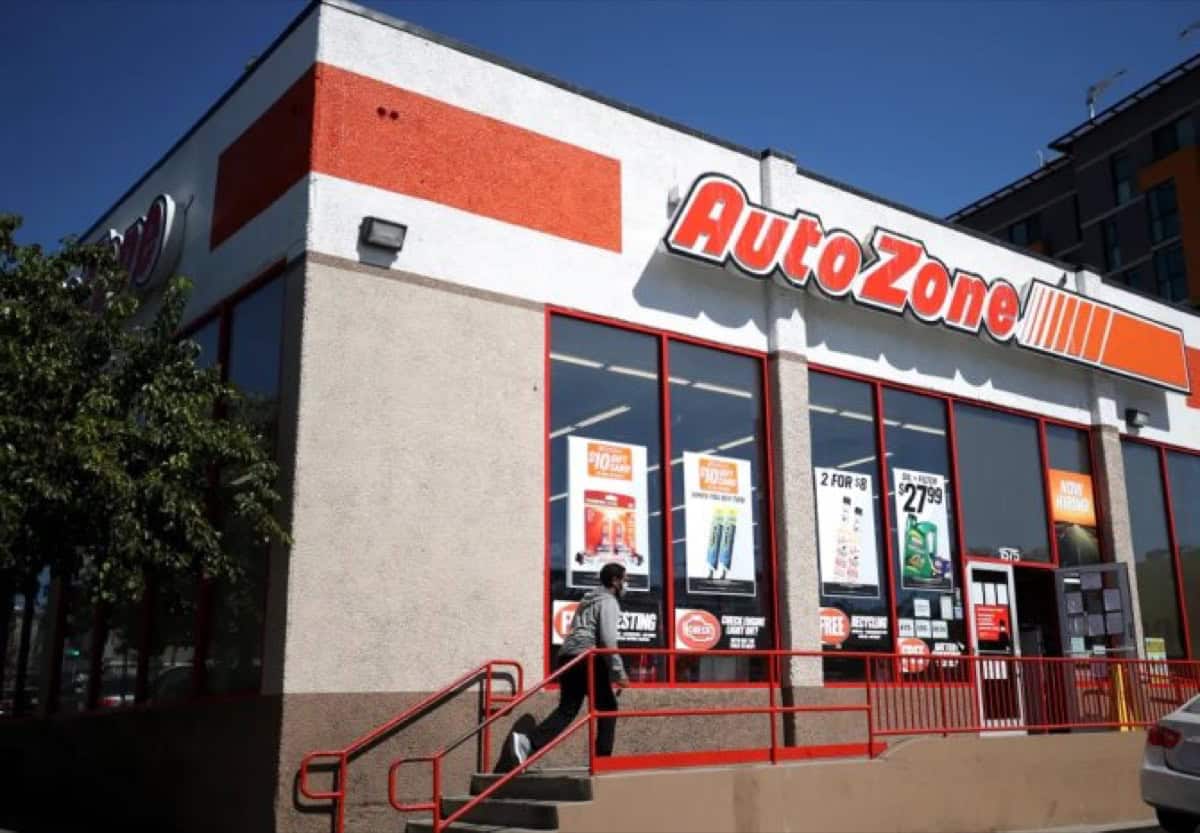
O'Reilly Auto Parts
- $957,188
O’Reilly NNN for Sale in Cabot, AR — $957K | 6.4% Cap
Cabot, Arkansas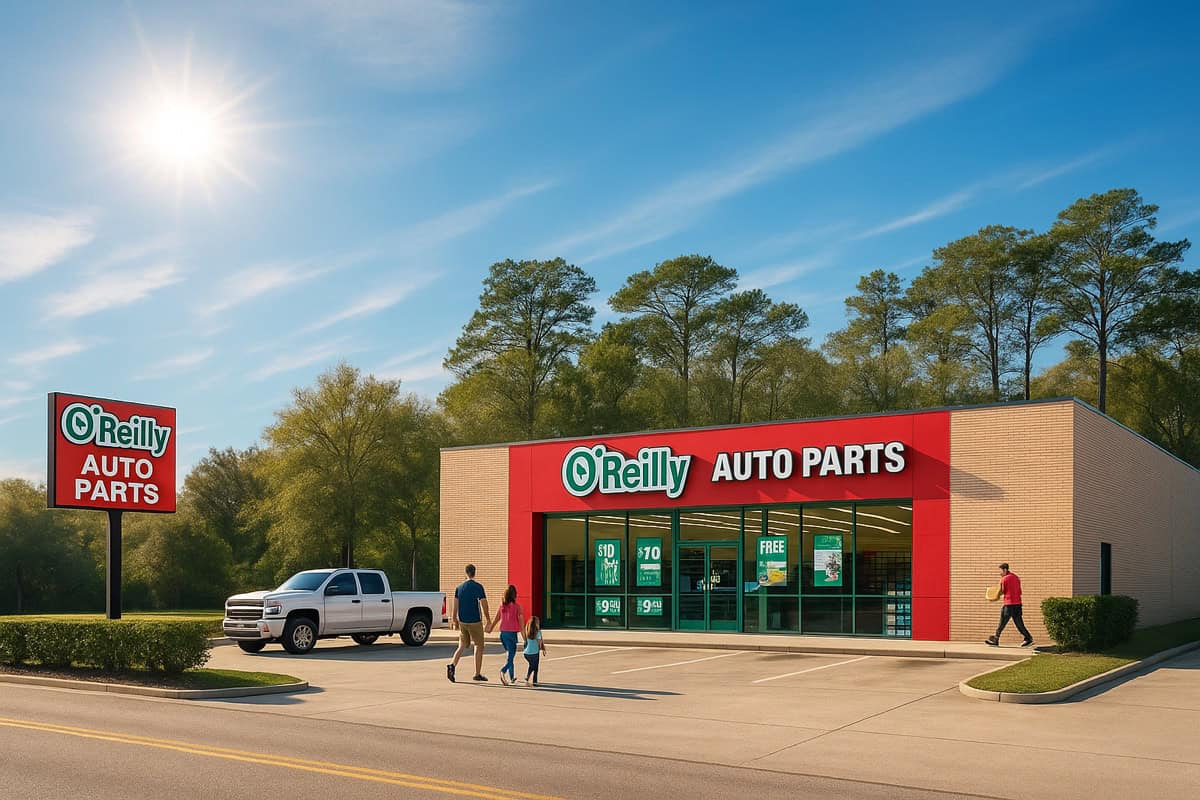
Advance Auto Parts
- $1,234,483
Advance Auto NNN for Sale in Mount Orab, OH — $1.2M | 7.25% Cap
Mount Orab, OhioAdvance Auto Parts
- $1,047,273
Advance Auto NNN for Sale in La Grange, KY — $1.0M | 8.25% Cap
La Grange, Kentucky
AutoZone
- $2,975,000
AutoZone NNN for Sale in Rio Grande City, TX — $3.0M | 4.75% Cap
Rio Grande City, Texas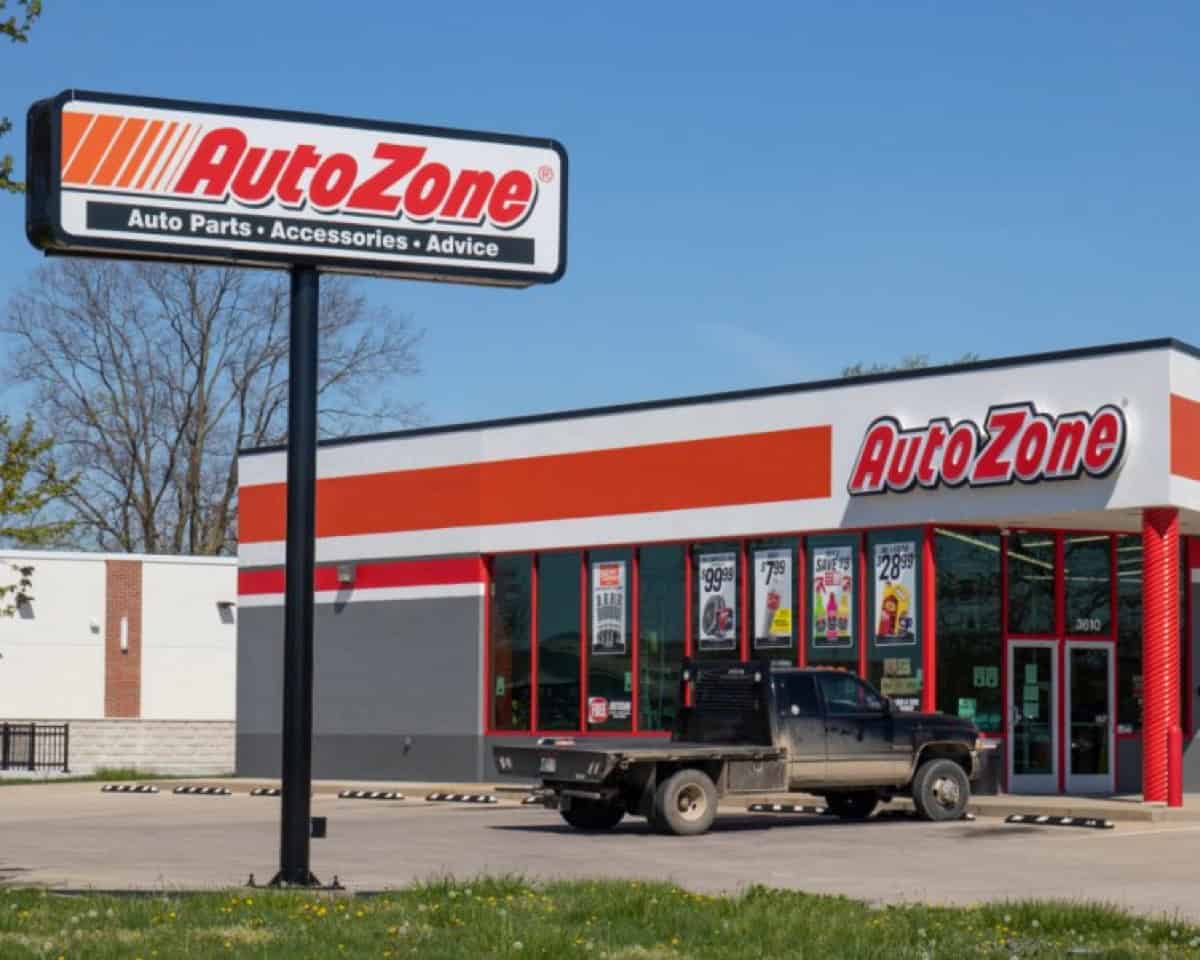
Advance Auto Parts
- $1,600,000
Advance Auto NNN for Sale in Chittenango, NY — $1.6M | 7.5% Cap
Chittenango, New YorkAdvance Auto Parts
- $993,243
Advance Auto NNN for Sale in Kalkaska, MI — $993K | 7.4% Cap
Kalkaska, MichiganAutoZone
- $2,005,000
AutoZone NNN for Sale in Homestead, FL — $2.0M | 4.5% Cap
Homestead, FloridaO'Reilly Auto Parts
- $957,188
O’Reilly NNN for Sale in Cabot, AR — $957K | 6.4% Cap
Cabot, ArkansasAdvance Auto Parts
- $1,234,483
Advance Auto NNN for Sale in Mount Orab, OH — $1.2M | 7.25% Cap
Mount Orab, OhioAdvance Auto Parts
- $1,047,273
Advance Auto NNN for Sale in La Grange, KY — $1.0M | 8.25% Cap
La Grange, KentuckyAutoZone
- $2,975,000
AutoZone NNN for Sale in Rio Grande City, TX — $3.0M | 4.75% Cap
Rio Grande City, TexasAdvance Auto Parts
- $1,600,000
Advance Auto NNN for Sale in Chittenango, NY — $1.6M | 7.5% Cap
Chittenango, New York7-Eleven NNN Properties for Sale: #1 Convenience Store Investment (2026 Guide)
7-Eleven NNN properties represent America’s leading convenience store chain with 13,000+ US locations and 24/7 operations, which strengthens the long-term reliability of a 7-eleven NNN lease for passive investors.
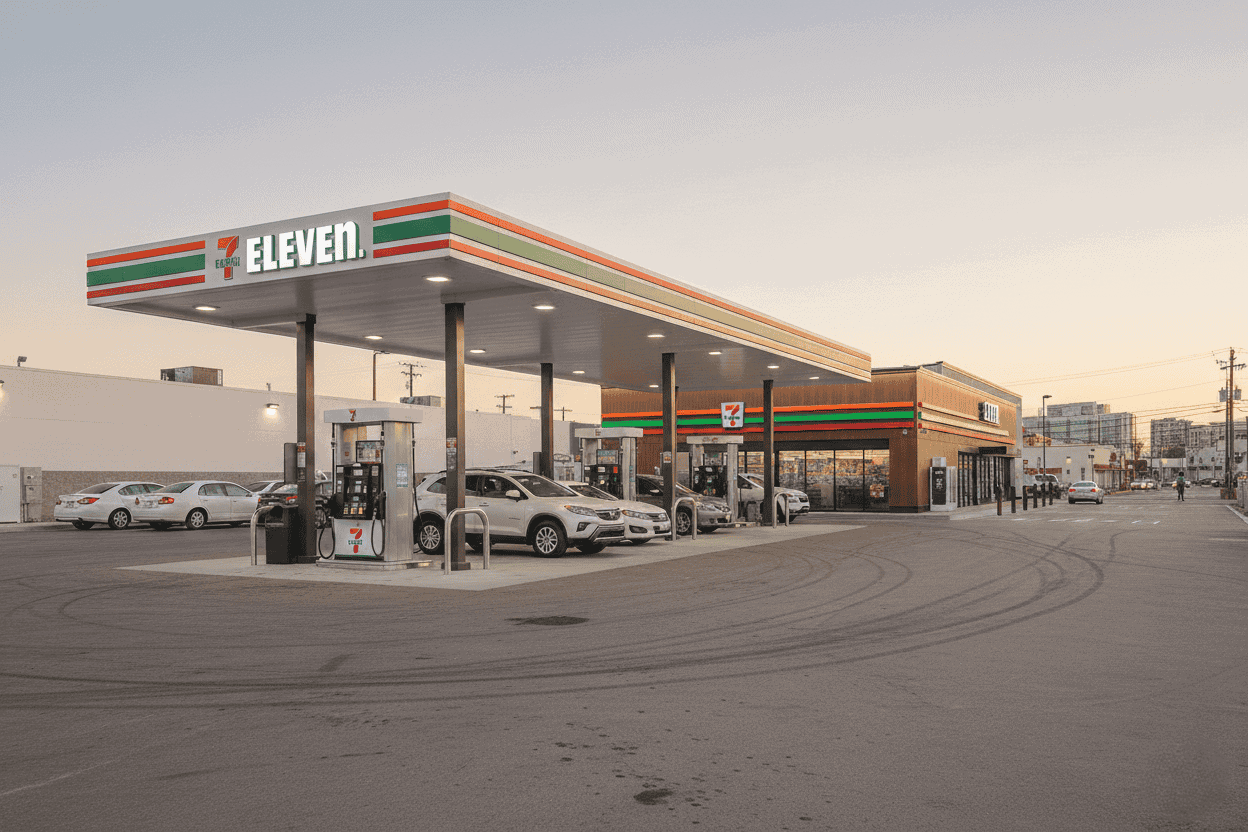
Investors searching for a 7 eleven for sale will find that 7-Eleven NNN properties represent America’s leading convenience store chain with 13,000+ US locations and 24/7 operations.
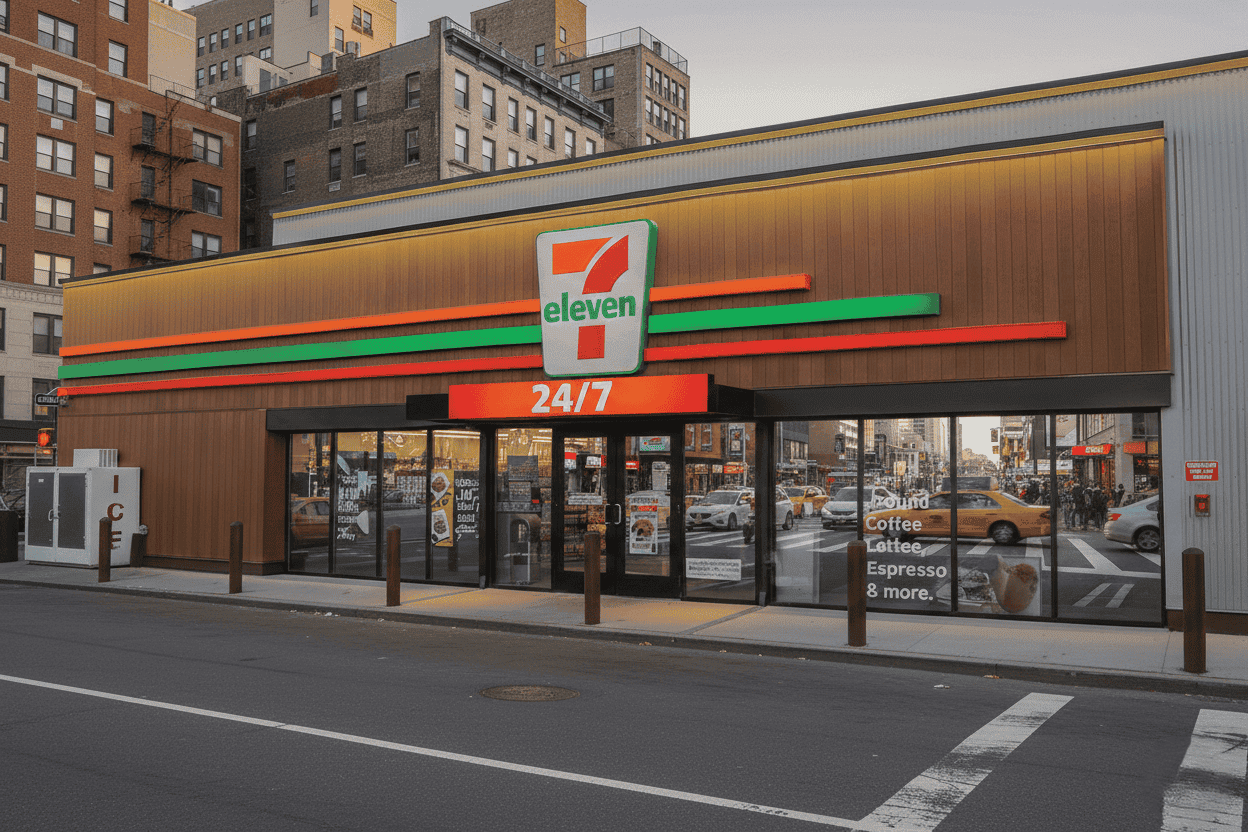
providing constant revenue, dual income streams (fuel + merchandise), and investment-grade corporate backing creating exceptional stability for passive income investors seeking high-traffic essential retail.
[afb_listing_carousel
tax_property_type=”automotive”
American Net Lease specializes in 7-Eleven NNN investments nationwide. Browse current listings or call 239.236.2626 to discuss exclusive convenience store opportunities.
Why a 7 Eleven for Sale Is a Strong Investment?
7-Eleven combines the nation’s #1 convenience store footprint (13,000+ US stores, 84,000+ globally) with 24/7 operations ensuring continuous revenue, strategic high-traffic locations, dual profit centers (fuel sales + merchandise), and corporate backing from Seven & i Holdings ($65+ billion Japanese parent), creating unique triple net lease investment opportunities. Investors searching for a 7 eleven for sale should focus on high-traffic locations with corporate guarantees, which maximize both revenue potential and long-term stability.
1. World’s Largest Convenience Store Chain
7-Eleven dominates global convenience retail:
Company overview:
- US stores: 13,000+ locations across America
- Global footprint: 84,000+ stores in 19 countries
- Market position: #1 convenience store globally
- Parent company: Seven & i Holdings (Tokyo: 3382)
- Market cap: $65+ billion (parent company)
- Founded: 1927 (nearly 100 years operating history)
Business model:
- Franchised: 95%+ of US stores (franchisee-operated)
- Corporate: Select company-operated locations
- Licensing: 7-Eleven brand globally recognized
- Support: Corporate provides systems, marketing, supply chain
- Revenue model: Franchise fees + real estate ownership/leasing
Store economics:
- Average size: 2,400-3,200 sq ft (compact footprint)
- Fuel pumps: 8-12 positions typical (4-6 MPDs)
- Inside sales: $1.2M-2M+ annually (varies by location)
- Fuel gallons: 100K-300K+ monthly (high-volume sites)
- Operating hours: 24/7/365 (continuous operations)
#1 convenience brand + Global scale = Strong tenant
2. 24/7 Operations & Continuous Revenue
7-Eleven never closes:
24-hour advantage:
- Open all day, every day (365 days/year)
- No downtime: Revenue generation continuous
- Night shift: 30-40% of sales (late-night consumers)
- Emergency purchases: Customers need 24/7 access
- Competitive edge: Many competitors close overnight
Customer traffic patterns:
- Morning rush: 6-9 AM (coffee, breakfast, commuters)
- Lunch: 11 AM-2 PM (sandwiches, snacks, beverages)
- After work: 4-7 PM (dinner items, beer/wine, gas)
- Late night: 10 PM-2 AM (snacks, drinks, essential items)
- Overnight: 2-6 AM (shift workers, travelers, emergencies)
Revenue implications:
- Sales spread across 24 hours (not just day shift)
- Higher total sales volume (vs limited hours)
- Attracts locations: Hospitals, airports, highways
- Customer loyalty: “Always open when I need it”
Operational stability:
- Labor costs higher (24/7 staffing)
- BUT sales justify (revenue covers expenses)
- Security: LED lighting, cameras (crime deterrent)
- Franchise support: 24-hour corporate assistance
24/7 = Maximum revenue generation + Essential service positioning
3. Dual Revenue Streams: Fuel + Merchandise
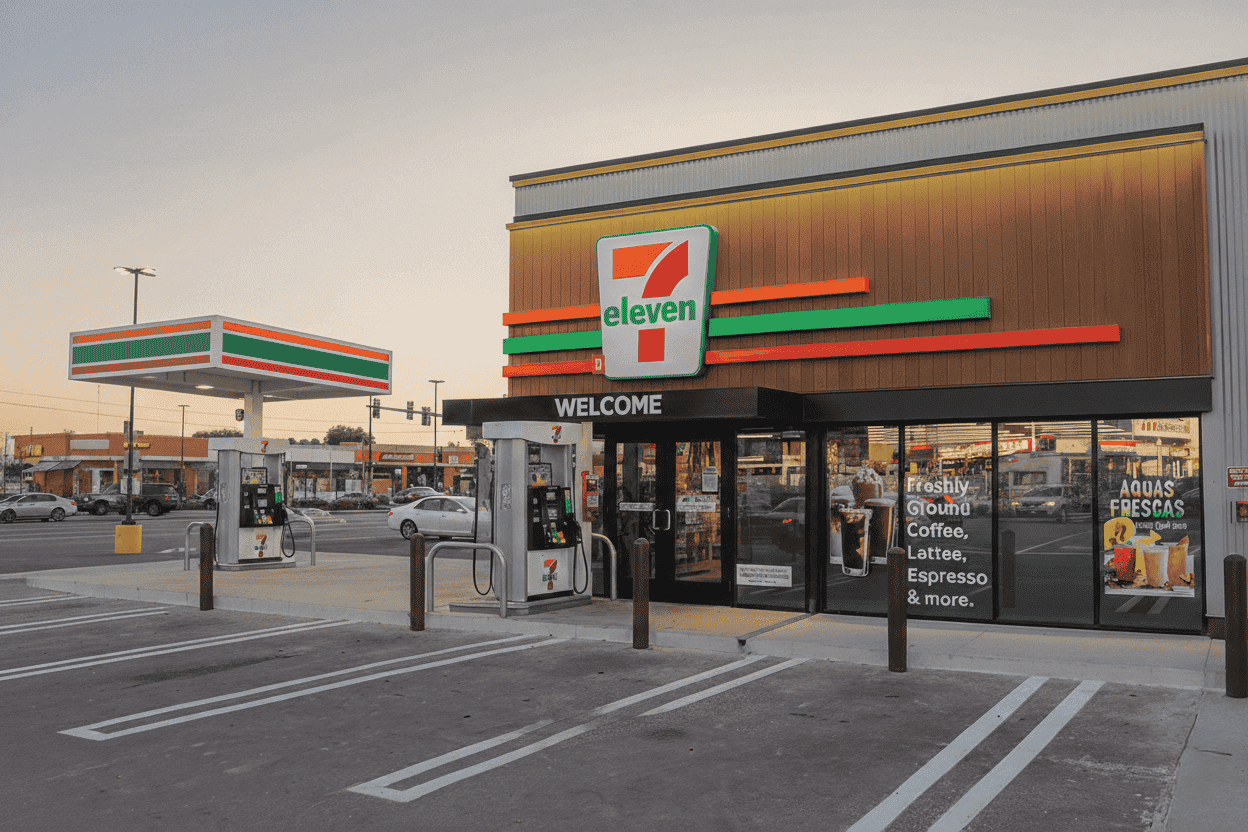
7-Eleven captures customers twice:
Fuel revenue (high volume, low margin):
- Fuel sales: 60-70% of total revenue
- Margin: 10-20 cents per gallon typical
- Volume: 100K-300K gallons monthly
- Fuel profit: $10K-60K monthly (varies by volume/margin)
- Traffic driver: Customers come for gas, buy inside
Merchandise revenue (lower volume, high margin):
- Inside sales: 30-40% of total revenue
- Margin: 30-40% gross profit typical
- Categories: Beverages, snacks, food, tobacco, lottery
- Merchandise profit: Often exceeds fuel profit
- Higher margin = More profitable per dollar sold
Synergy between fuel and merchandise:
- Fuel brings traffic (customers filling up)
- 60-70% buy something inside (impulse purchases)
- Merchandise margin offsets fuel competition
- Combo = Resilient business model
Proprietary products:
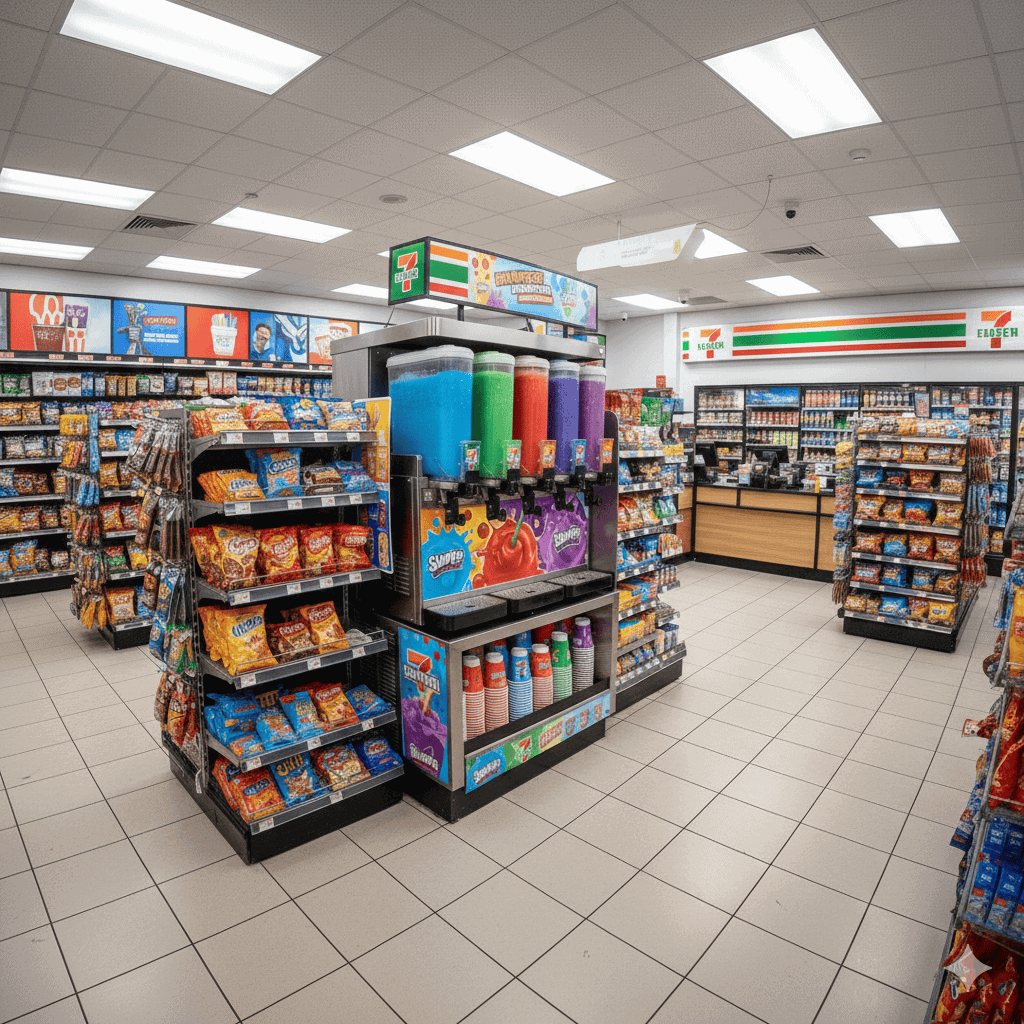
- Slurpee: Iconic frozen beverage (high margin)
- Big Gulp: Large fountain drinks (brand recognition)
- Hot foods: Pizza, sandwiches, breakfast (food service)
- Private label: 7-Select brand (exclusive products)
Dual streams = Diversified revenue, recession resilience
4. Strategic High-Traffic Locations
7-Eleven targets maximum visibility:
Location strategy:
- Corner lots: Signalized intersections preferred
- Highway exits: Interstate visibility, traveler traffic
- Urban density: Metropolitan areas, dense suburbs
- Commuter corridors: Daily traffic patterns
- Residential proximity: Walk-in customer base
Traffic requirements:
- Vehicle count: 15,000-30,000+ daily (minimum)
- Urban: Higher foot traffic, less fuel focus
- Suburban: Balanced fuel + merchandise
- Highway: Fuel-dominant, traveler focus
Competitive positioning:
- First-mover advantage: Secures best corners early
- Site selection: Sophisticated analytics
- Real estate control: 7-Eleven often owns land
- Long-term hold: Not relocating frequently
Demographics targeted:
- Middle income: $40K-$80K household income
- Age: 18-54 (broad appeal)
- Daily commuters: Regular repeat customers
- Families: Convenience for busy households
High traffic = High sales volume + Property value stability
5. Investment-Grade Corporate Backing
Seven & i Holdings provides institutional strength:
Parent company (Seven & i Holdings):
- Tokyo Stock Exchange: 3382
- Market cap: $65+ billion (JPY 10+ trillion)
- Revenue: $80+ billion annually
- Operating income: $3+ billion
- Credit rating: BBB- investment grade (S&P)
Diversified portfolio:
- 7-Eleven: Global convenience leader
- Speedway: Acquired 2021 ($21B, 3,900+ stores merged into 7-Eleven)
- Ito-Yokado: Japanese supermarkets
- Department stores: Sogo & Seibu (Japan)
- Financial services: 7-Bank in Japan
US operations:
- 7-Eleven Inc: US subsidiary
- Headquarters: Irving, Texas
- Corporate guarantee: Varies by deal structure
- Franchise model: Most stores franchisee-operated
- Real estate: Corporate owns/leases, then sublet to franchisees
Financial strength:
- Consistent profitability: 97 years operating history
- Global diversification: Revenue across 19 countries
- Speedway acquisition: $21B investment = commitment to US market
- Cash generation: Strong free cash flow
Corporate backing = Stability + Long-term commitment
6. Franchise Model & Lease Structure
Understanding 7-Eleven NNN lease complexity:
Corporate vs franchisee:
- Corporate-operated: 7-Eleven Inc operates directly
- Franchised: Local operator under 7-Eleven license
- Corporate guarantee: Required for NNN investor protection
- Lease structure: Corporate master lease, franchisee sublease
Typical lease terms:
- Initial term: 15-20 years (corporate guarantee)
- Renewal options: 2-4 five-year periods
- Rent increases: 10% every 5 years or 1.5-2% annually
- Triple net: Tenant pays property tax, insurance, maintenance
- Guarantor: 7-Eleven Inc (not franchisee individual)
Critical lease provisions:
- Corporate guarantee: Essential (verify Seven & i or 7-Eleven Inc)
- Performance clauses: Rare but review (sales thresholds)
- Relocation rights: Sometimes included (franchisee may move)
- Fuel tank compliance: Environmental responsibility (review)
- Renewal likelihood: Strong locations 70-80%
Speedway integration:
- 3,900+ Speedway stores acquired 2021
- Converting to 7-Eleven brand (multi-year process)
- Real estate implications: Some closures/consolidations
- Due diligence: Verify if former Speedway (integration status)
Lease structure critical = Verify corporate guarantee specifics
7. Reasonable Cap Rates for C-Store Sector
7-Eleven properties balance location quality with yields:
Typical cap rates by location (2026):
- Highway/Interstate: 6.5-7.5% (highest volume, fuel-focused)
- Suburban high-traffic: 6.0-7.0% (balanced fuel + merchandise)
- Urban dense areas: 5.5-6.5% (lower fuel, high inside sales)
- Secondary markets: 7.0-7.5% (established but lower traffic)
Cap rate drivers:
- Credit quality: BBB- investment grade (moderate caps)
- Location: Highway premium, urban stability
- Fuel volume: Higher gallons = lower caps (more valuable)
- Lease term: 15-20 years = stability
- Store format: Newer larger stores = premium
Price range:
- Highway high-volume: $3M-6M+
- Suburban established: $2M-3.5M
- Urban dense: $2.5M-4M
- Secondary markets: $1.5M-2.5M
Returns analysis:
- Cap rate: 6-7.5% income
- Appreciation: 2-4% (location-dependent)
- Total return: 8-11.5% potential
- Fuel volatility: Margins fluctuate (merchandise stabilizes)
C-store sector = Higher yields than QSR, lower than dollar stores
8. Essential Service & Recession Resilience
7-Eleven thrives in all economic environments:
Essential service factors:
- Fuel: Non-discretionary (people need to drive)
- Convenience: Time-saving (value in busy lives)
- Food/beverages: Daily necessities (coffee, milk, bread)
- Tobacco/lottery: Habitual purchases (recession-resistant)
- Emergency items: Late-night needs (always required)
Recession performance (2008-2009):
- Store traffic: Maintained (essential purchases)
- Fuel sales: Slight decline (less driving) but stabilized
- Inside sales: Resilient (value focus, smaller purchases)
- Store closures: Minimal (strong locations survived)
- Market share: Gained (independent operators closed)
COVID-19 pandemic (2020-2021):
- Essential business: Stores remained open
- Fuel sales: Declined initially (lockdowns) then recovered
- Merchandise: Strong (convenience valued, stockpiling)
- Expansion: Speedway acquisition during pandemic ($21B)
- Resilience: Demonstrated essential service positioning
Value proposition during downturns:
- Cheaper than restaurants: Prepared food value
- Closer than supermarkets: Convenience saves time/gas
- Small purchases: $5-20 transactions manageable
- Immediate gratification: No delivery wait
Essential + Convenient = Recession-resistant tenant
7-Eleven NNN Investment Strategies
Highway Interstate Exits
Maximum fuel volume locations:
Target characteristics:
- Interstate highway exits (I-5, I-95, I-10, etc.)
- Truck traffic: Commercial drivers frequent customers
- Traveler traffic: Road trip fill-ups, snacks
- Fuel volume: 150K-300K+ gallons monthly
- Visibility: Highway signage, easy on/off access
Advantages:
- Highest fuel sales (volume drives revenue)
- Strong merchandise (travelers buy snacks/drinks)
- Consistent traffic (highways don’t close)
- Less local competition (interstate advantage)
- Appreciation: Highway properties stable value
Investment profile:
- Purchase: $3M-6M+
- Cap rate: 6.5-7.5%
- Lease: 15-20 years
- Focus: Fuel volume + High yields
Considerations:
- Fuel price sensitivity (margin compression risk)
- Environmental compliance (underground tanks)
- Economic cycles (less driving = volume drop)
Fuel-volume focused investors
Urban Dense Metropolitan
High merchandise sales locations:
Target characteristics:
- Dense urban neighborhoods (NYC, SF, Chicago, Boston)
- Walk-in traffic: Residential density, foot traffic
- Transit proximity: Subway, bus stops nearby
- Inside sales focus: Less fuel, more merchandise
- 24/7 advantage: Night shift workers, late-night customers
Advantages:
- Property appreciation: Urban real estate growth
- Merchandise margin: Higher-profit products
- Stable traffic: Dense population base
- Less fuel dependency: Inside sales primary
- Recession resilience: Urban density maintains traffic
Investment profile:
- Purchase: $2.5M-4M
- Cap rate: 5.5-6.5%
- Lease: 15-20 years
- Focus: Urban appreciation + Merchandise
Considerations:
- Lower yields (urban premium pricing)
- Smaller footprint (space constraints)
- Parking limitations (urban density)
Appreciation-focused urban investors
Suburban Commuter Corridors
Balanced fuel + merchandise:
Target characteristics:
- Major suburban arterials (traffic 20K-30K daily)
- Commuter corridors: Daily predictable traffic
- Residential proximity: Neighborhood access
- Balanced sales: 60% fuel, 40% merchandise
- Corner location: Signalized intersection
Advantages:
- Balanced revenue: Both streams healthy
- Predictable traffic: Daily commuter patterns
- Demographics: Middle/upper-middle income
- Stability: Suburban growth markets
- Yields: 6-7% reasonable
Investment profile:
- Purchase: $2M-3.5M
- Cap rate: 6.0-7.0%
- Lease: 15-20 years
- Focus: Balance + Stability
Balanced income + growth investors
Secondary Market Established
Proven performers in smaller metros:
Target characteristics:
- Regional cities: 100K-500K population
- Established location: 10+ years operating
- Local dominance: Limited competition
- Demographics: Working/middle class
- Fuel + merchandise: Both revenue streams
Advantages:
- Higher yields: 7-7.5% caps
- Lower entry: $1.5M-2.5M
- Proven history: Operating track record
- Less competition: Fewer institutional buyers
- Stable market: Established customer base
Investment profile:
- Purchase: $1.5M-2.5M
- Cap rate: 7.0-7.5%
- Lease: 10-20 years
- Focus: Yield + Cash flow
Income-focused investors seeking higher returns
Evaluating 7 Eleven for Sale Locations for Maximum ROI
Critical Location Analysis
7-Eleven performance is location-dependent:
Traffic & visibility:
- Vehicle count: 15,000-30,000+ daily minimum
- Corner location: Signalized intersection ideal
- Highway access: Interstate exits premium
- Visibility: Signage visible from road
- Ingress/egress: Easy in-and-out access
Demographics:
- Population: 10,000+ within 3-mile radius
- Median income: $40K-$80K household
- Age: 25-54 primary (working population)
- Commuters: Daily predictable traffic
- Employment: Job centers nearby
Competition assessment:
- Other 7-Eleven: Within 2-3 miles (saturation?)
- Circle K, Wawa, Sheetz: Direct c-store competition
- Gas stations: Shell, BP, Chevron with c-stores
- Dollar stores: Alternative for snacks/beverages
- Market share: 7-Eleven dominance or fragmented
Fuel dynamics:
- Fuel pumps: 8-12 positions (4-6 MPDs) ideal
- Gallons monthly: 100K-300K+ (verify volume)
- Pricing: Competitive with nearby stations
- Margin: 10-20 cents per gallon typical
- Fuel supplier: Contract terms (review)
Store Performance Evaluation
Critical 7-Eleven metrics:
Sales indicators (if available):
- Strong: $2M-4M+ total annual sales
- Fuel: 100K-300K gallons monthly (volume)
- Inside: $1.2M-2M+ merchandise annually
- Average: $1.5M-2.5M total sales
- Weak: Under $1.5M (investigate)
Operating characteristics:
- Format: Standard 2,400-3,200 sq ft
- Fuel: Multi-product dispenser (MPD) positions
- 24/7: Confirmed (some rural may close overnight)
- Proprietary: Slurpee, Big Gulp, hot food present
- Technology: Payment systems, loyalty app integration
Speedway conversion status:
- Former Speedway: Acquired 2021 (3,900+ stores)
- Conversion timeline: Multi-year to 7-Eleven brand
- Integration: Some closures/consolidations occurring
- Due diligence: Verify conversion status, lease terms
Red flags:
- Declining sales: Multiple years downward trend
- Speedway overlap: Multiple stores close together
- Fuel tank issues: Environmental compliance problems
- Franchise turnover: Multiple operators in short time
- Deferred maintenance: Aging equipment, building condition
Lease Structure Review
Critical 7-Eleven lease provisions:
Guarantor verification (CRITICAL):
- 7-Eleven Inc: Required (US subsidiary)
- Seven & i Holdings: Acceptable (parent company)
- Franchisee only: NOT ACCEPTABLE (need corporate)
- Credit rating: BBB- confirmed (investment grade)
- Guarantee term: Full initial lease term minimum
Lease length:
- 15-20 years: Preferred (stability)
- 10-15 years: Acceptable (verify renewals)
- Under 10 years: Higher risk (re-leasing soon)
Rent structure:
- Base rent: Fixed monthly amount
- Escalations: 10% every 5 years or 1.5-2% annually
- Percentage rent: Sometimes (rare in NNN)
- Options: 2-4 five-year renewals typical
Special provisions:
- Environmental: Fuel tank responsibility (CRITICAL)
- Above-ground tanks: Lower risk
- Underground: Verify compliance, insurance
- Liability: Tenant vs landlord (negotiate)
- Relocation: Franchisee may move (review carefully)
- Performance: Sales thresholds (rare but scrutinize)
- Renewal: Automatic or at tenant option
Environmental due diligence (ESSENTIAL):
- Phase I ESA: Required (environmental assessment)
- UST compliance: Underground storage tank testing
- LUST: Check for leaking underground storage tanks
- Remediation: Past contamination cleaned up?
- Insurance: Environmental liability coverage
Financial Underwriting
7-Eleven property analysis:
Revenue verification:
- Rent: Verify current base rent amount
- Escalations: Calculate future rent increases
- Renewal options: Project renewal rent
- CAM/NNN: Verify tenant pays (triple net)
Expense estimation:
- Property tax: 1-2% of property value annually
- Insurance: $2,000-$5,000+ (fuel increased premium)
- Maintenance: Minimal (tenant responsibility)
- Management: 3-5% if using property manager
- Reserves: 3-5% for major repairs
Cap rate analysis:
- Market cap rate: 6-7.5% typical range
- Your cap rate: Calculate (NOI / Purchase Price)
- Compare: Similar 7-Eleven sales in area
- Risk adjustment: Location quality, lease term
Cash flow projection:
- Year 1-5: Base rent
- Year 6-10: After first escalation (+10%)
- Year 11-15: After second escalation (+10%)
- Year 16-20: After third escalation (+10%)
- Renewal: Conservative assumption (70-80% likelihood)
Current 7-Eleven NNN Properties for Sale
Featured 7-Eleven NNN Listings:
Looking for specific 7-Eleven properties by market? Contact our specialists at 239.236.2626 for exclusive nationwide opportunities.
7-Eleven Investment Case Study
Investment Profile: 7-Eleven – Dallas Suburban Highway Exit
Property Details:
- Tenant: 7-Eleven Inc (subsidiary of Seven & i Holdings)
- Guarantee: Corporate guarantee (BBB- credit rating)
- Purchase Price: $3,200,000
- Cap Rate: 7.0%
- Annual NOI: $224,000
- Lease Term: 18 years (franchisee-operated, corporate lease)
- Rent Increases: 10% every 5 years
- Location: Plano, Texas (Dallas northern suburb)
Property Features:
- Highway access: I-75 (Central Expressway) exit
- 2,800 sq ft convenience store
- 10 fuel pumps (5 MPDs), high-volume location
- Corner lot, 0.6 acres
- Traffic count: 28,000 vehicles/day
- Build date: 2018 (newer format)
Market Details:
- Plano: Median income $95,000 (affluent suburb)
- Population: 50,000+ within 3-mile radius
- Employment: Corporate headquarters nearby (Toyota, Liberty Mutual, JPMorgan Chase)
- Commuter corridor: Daily predictable traffic
- Competition: Limited (nearest c-store 1.5 miles)
Sales performance:
- Fuel: 180,000 gallons monthly (high volume)
- Inside: $1.8M annually (strong merchandise)
- Total: $3.5M+ annual sales (excellent performance)
- Franchisee: Established operator, 5 locations in Dallas
Investor Profile: California 1031 exchange investor. Sold Bay Area apartment building ($4.5M, $2M gain). Sought: exit California 13.3% tax, Texas 0% tax advantage, convenience store exposure, higher cap rate, corporate guarantee stability.
Tax advantage:
- Annual NOI: $224,000
- California state tax saved: $29,912 (13.3%)
- Texas state tax: $0 (0%)
- Annual tax savings: $29,912 (CA vs TX)
- 18-year tax savings: $538,416
Performance to date:
- Purchase: June 2023
- Current: February 2026 (32 months)
- 100% on-time rent payments
- Franchisee performance: Strong (sales growing)
- Property value: Estimated $3,520,000 (10% appreciation)
- Plano market: Continued corporate growth
18-Year Income Projection:
- Years 1-5: $224,000 annual NOI ($1.12M cumulative)
- Years 6-10: $246,400 annual NOI (+10%, $1.232M cumulative)
- Years 11-15: $271,040 annual NOI (+10%, $1.355M cumulative)
- Years 16-18: $298,144 annual NOI (+10%, $894,432 for 3 years)
- Total 18-year income: $4,601,432
- CA tax savings: $538,416 (vs California ownership)
- Projected value (Year 18): $4M+ (Plano appreciation)
- Total return: 120%+ over 18 years (income + appreciation + tax)
Investor testimonial: “This 7-Eleven in Plano is exactly what I wanted. I’m getting 7% cap rate vs 4-5% I’d get on apartments in the Bay Area, and I’m saving $30,000 a year in California state taxes since Texas has zero income tax. The location is bulletproof—right off I-75 with 28,000 cars a day, affluent demographics, and corporate headquarters all around. The franchisee is crushing it with 180,000 gallons of fuel monthly and nearly $2M in inside sales. Corporate guarantee from 7-Eleven gives me confidence even though it’s a franchisee operating it.”
Frequently Asked Questions
Are 7-Eleven NNN properties safe investments?
Yes, 7-Eleven NNN properties are generally safe when properly underwritten.
Strengths: BBB- investment-grade credit (Seven & i Holdings $65B+ parent), #1 convenience store (13,000+ US stores, 84,000+ globally), 24/7 operations (continuous revenue), dual revenue (fuel + merchandise diversification), essential service (recession-resistant).
Risks: Franchise model (verify corporate guarantee), environmental liability (fuel tanks), fuel margin volatility (margins fluctuate with oil prices), Speedway integration (3,900 stores acquired, some consolidation).
Safety factors: Require 7-Eleven Inc or Seven & i corporate guarantee (NOT franchisee only), conduct Phase I Environmental Site Assessment (fuel tanks), verify high traffic (20,000+ vehicles daily), confirm strong sales ($2M+ annually if data available).
High-volume locations with corporate guarantee and clean environmental history are very safe; marginal locations with weak guarantees carry real risk.
What are typical cap rates for 7-Eleven properties?
7-Eleven NNN properties offer 6-7.5% cap rates depending on location and fuel volume.
Highway/Interstate exits: 6.5-7.5% (highest volume, fuel-dominant), Suburban high-traffic: 6-7% (balanced fuel + merchandise), Urban dense: 5.5-6.5% (lower fuel, strong inside sales), Secondary markets: 7-7.5% (established, lower traffic).
Cap rate drivers: Credit quality (BBB- investment grade), Fuel volume (higher gallons = more valuable), Location (highway premium, urban stability), Lease term (15-20 years), Store condition (newer larger formats preferred).
Comparison: Higher than QSR (McDonald’s 5-5.5%), Lower than dollar stores (7-7.5%), Similar to gas stations (6.5-7.5%). C-store sector: Higher yields reflect fuel volatility risk, dual revenue provides stability. Focus: Total return = cap rate + appreciation + fuel volume growth potential.
How does 7-Eleven compare to other C-store chains?
7-Eleven NNN properties offer 6-7.5% cap rates depending on location and fuel volume. Highway/Interstate exits: 6.5-7.5% (highest volume, fuel-dominant), Suburban high-traffic: 6-7% (balanced fuel + merchandise), Urban dense: 5.5-6.5% (lower fuel, strong inside sales), Secondary markets: 7-7.5% (established, lower traffic).
A typical 7 eleven for sale offers dual revenue streams from fuel and merchandise, making these locations attractive to investors seeking stable returns.
Cap rate drivers: Credit quality (BBB- investment grade), Fuel volume (higher gallons = more valuable), Location (highway premium, urban stability), Lease term (15-20 years), Store condition (newer larger formats preferred).
Comparison: Higher than QSR (McDonald’s 5-5.5%), Lower than dollar stores (7-7.5%), Similar to gas stations (6.5-7.5%). C-store sector: Higher yields reflect fuel volatility risk, dual revenue provides stability. Focus: Total return = cap rate + appreciation + fuel volume growth potential.
Should I worry about environmental issues with fuel tanks?
Yes, environmental due diligence is CRITICAL for any fuel-related property.
Fuel tank risks: Underground Storage Tanks (USTs) can leak, contaminate soil/groundwater, cost $100K-$1M+ to remediate, create long-term liability.
Essential protections: Phase I Environmental Site Assessment (required, $2K-5K), UST compliance testing (verify tanks meet regulations), Leaking UST (LUST) database check (past contamination?), Environmental insurance (pollution liability coverage), Lease review (tenant vs landlord environmental responsibility).
Who pays for cleanup: Typical NNN lease: Tenant responsible during tenancy, Landlord: Responsible for pre-existing contamination.
Historical: Previous owners may have liability.
Risk mitigation: Buy properties with above-ground fuel tanks (lower risk), Verify UST compliance certification (testing current), Confirm environmental insurance (tenant coverage), Negotiate indemnification (tenant protects landlord), Consider environmental reserve (escrow for potential issues).
Deal-breakers: Known contamination not remediated, Aging USTs (20-30+ years old, high risk), No environmental insurance, Tenant refuses environmental responsibility.
Recommendation: ALWAYS conduct Phase I ESA before purchasing any fuel-related property. Environmental liability can exceed property value—protect yourself.
Can I use 1031 exchange to buy 7-Eleven property?
Yes! 7-Eleven NNN properties are excellent 1031 exchange targets for c-store exposure.
Benefits: Defer capital gains, exit high-tax states (CA 13.3% → TX/FL 0%), essential service exposure (recession-resistant), 24/7 operations (continuous income), corporate guarantee protection.
Popular exchanges: Gas station → 7-Eleven (stay in fuel retail, upgrade to corporate), Apartment → 7-Eleven (simplify to single tenant, reduce management), California property → Texas 7-Eleven (eliminate state tax, maintain cashflow), Retail center → 7-Eleven (consolidate to single property).
7-Eleven 1031 advantages: Wide price range ($1.5M-6M+ accommodates various exchanges), Available nationwide (multiple markets), Corporate guarantee (investment-grade protection), Essential service (long-term stability).
Process: Identify within 45 days, close within 180 days, equal-or-greater value, qualified intermediary. Critical: Verify corporate guarantee (7-Eleven Inc), complete Phase I ESA (environmental), confirm high traffic/sales. We coordinate 7-Eleven 1031 exchanges with full environmental due diligence.
What’s the Speedway acquisition impact on investors?
Seven & i’s $21 billion Speedway acquisition (2021) signals massive US commitment but requires due diligence.
The facts: 3,900 Speedway stores acquired from Marathon Petroleum, Converting to 7-Eleven brand (multi-year process), Some overlap/consolidation occurring (markets with both brands),
Integration: Rebranding, systems, loyalty programs. Investor implications: Positive: $21B investment = long-term US commitment, Scale increases (13,000 → 17,000 stores when complete), Market consolidation (reducing competition).
Concerns: Store closures (overlapping markets being rationalized), Lease changes (some Speedway leases being renegotiated), Brand transition (Speedway loyal customers adjusting).
Due diligence for former Speedway properties: Verify conversion timeline (7-Eleven brand complete?), Check overlap (other 7-Eleven/Speedway nearby = closure risk?), Review lease (guaranteed through conversion?), Confirm sales (performance during transition?).
Protection: Buy 7-Eleven-branded stores (not Speedway), Avoid markets with heavy overlap (3+ stores within 3 miles), Verify corporate guarantee unchanged. Overall: Acquisition strengthens 7-Eleven long-term, but creates short-term consolidation risk in some markets.
Do 7-Eleven stores close frequently?
7-Eleven store closure rate is low for strong locations but rising due to Speedway integration.
Closure factors: Store performance (weak sales = closure risk), Speedway overlap (duplicate markets being consolidated), Franchise turnover (operator exits, store may close temporarily), Real estate issues (lease expiration, relocation), Competition (new c-stores nearby).
Historical closure rate: Strong locations: 5-10% over 20 years (very stable), Weak locations: 20-30% over 20 years (higher risk), Speedway impact: Temporary increase (integration closures).
Protection strategies: Buy high-volume locations (180K+ gallons fuel, $1.5M+ inside sales), Avoid Speedway overlap markets, Verify long-term lease (15-20 years = commitment signal), Strong demographics (20,000+ daily traffic, affluent income), Corporate guarantee (ensures rent even if closed).
Renewal likelihood: Strong performers: 75-85% renewal rate, Average performers: 60-75%, Weak performers: 40-60% (may not renew).
Red flags indicating closure risk: Declining sales (multiple years downward), Speedway nearby converting to 7-Eleven, Franchise operator turnover (multiple in short time), Deferred maintenance (corporate not investing).
Due diligence critical: Request sales data, verify traffic counts, assess competition, confirm corporate commitment.
Is fuel price volatility a concern for 7-Eleven investments?
Yes, fuel margin volatility affects profitability but merchandise diversifies risk. Fuel dynamics: Retail price: Driven by wholesale cost + margin, Margin: 10-20 cents per gallon typical, Volatility: Margins compress when oil prices spike suddenly, Volume: More gallons sold = more total profit despite margin.
Investor protection through diversification: Merchandise sales: 30-40% of revenue, higher margin (30-40% gross profit), Inside sales: More profitable per dollar than fuel, Proprietary products: Slurpee, Big Gulp drive higher margin, Food service: Hot food, sandwiches add profit.
Why diversification matters: Fuel margin compression: Inside sales offset, Economic cycles: Consumers need convenience items, Recurring customers: Daily traffic less price-sensitive. Historical resilience: 2008 oil spike: Fuel margins compressed but merchandise steady, COVID-19: Fuel dropped initially but inside sales strong, 2022-2023 inflation: Higher prices, stable margins overall.
Landlord perspective (NNN investor): Rent is fixed: Fuel volatility doesn’t change rent payment, Corporate guarantee: 7-Eleven pays regardless of margins, Long lease: 15-20 years provides stability, Dual revenue: Balances overall tenant health. Conclusion: Fuel volatility is real but NNN investors protected by corporate lease + diversified merchandise revenue. Focus on total store performance, not just fuel.
Next Steps: Invest in 7-Eleven NNN Properties
Ready to add America’s #1 convenience store with 24/7 operations to your investment portfolio? American Net Lease provides access to 7-Eleven NNN opportunities nationwide with full environmental due diligence and corporate guarantee verification.
Work With American Net Lease
Why investors choose us for 7-Eleven NNN acquisitions:
- C-store expertise: Fuel volume analysis, environmental due diligence
- Lease verification: Corporate guarantee confirmation (7-Eleven Inc)
- Traffic analysis: Vehicle counts, demographic verification
- Environmental specialists: Phase I ESA coordination, UST compliance
- 1031 exchange coordination: Convenience store portfolio positioning
Schedule Your Free Consultation
Ready to invest in a 7 eleven for sale? Contact our specialists today to explore exclusive NNN opportunities nationwide.
📞 Call: 239.236.2626
📧 Email: Contact Us
🔍 Browse: View All 7-Eleven Properties
Additional Resources
Learn More About C-Store NNN Investing:
- Ultimate Triple Net Lease Guide — Comprehensive NNN education
- Gas Station NNN Properties — Compare fuel-based retail
Compare Investment Markets:
- Florida NNN Properties — Zero-tax opportunity
- Texas NNN Properties — Value leader, zero tax
- Arizona NNN Properties — Growth markets
Explore Other Tenant Types:
- McDonald’s NNN Properties — QSR leader
- Dollar General NNN Properties — Value retail
- Walgreens NNN Properties — Pharmacy leader
Build wealth with 7-Eleven NNN properties—#1 convenience store, 24/7 operations, dual revenue streams. Call 239.236.2626 or request information today.
Last Updated: February 2026